
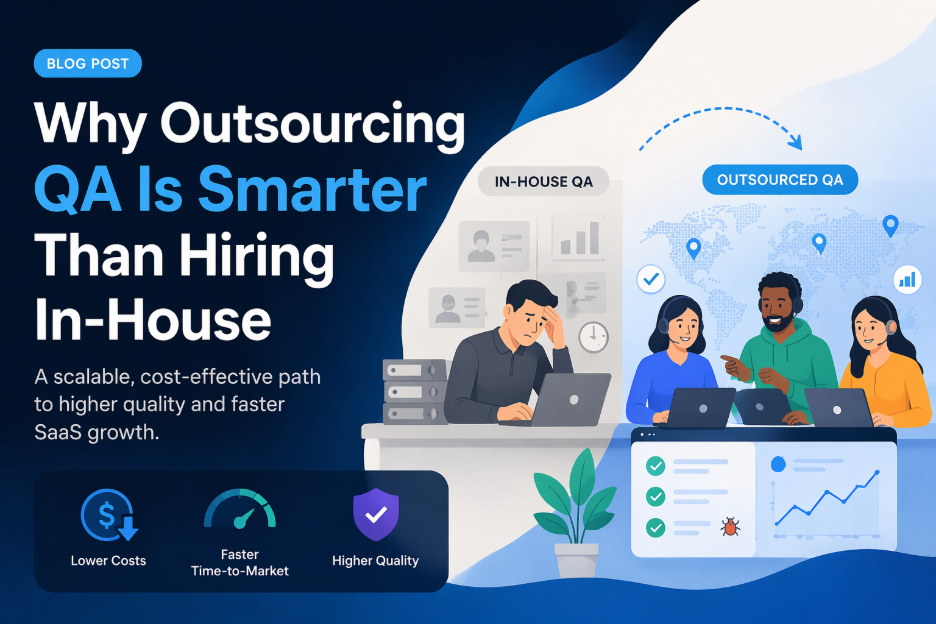
You just wrapped up a funding round, and now your engineering team is rolling out features at lightning speed. User growth is on the rise. On the surface, everything seems fantastic.
A major bug sneaks into production, causing significant disruption. Signups break. Payments fail. Your Slack blows up.
- Cost-Effectiveness: Outsourcing can help cut costs compared to hiring full-time staff
- Expertise: Third-party firms usually have specialized skills and experience
- Focus: Teams can focus on core tasks while experts handle QA
- Scalability: Outsourcing lets teams scale up or down quickly to meet their needs
In summary, outsourcing QA can be a good choice for many SaaS teams
The Real Cost of Building an In-House QA Team
Most founders do the math wrong when comparing in-house vs. outsourcing.
They look at a QA engineer’s salary and call it done. But the real number is much higher. Think about the extra costs: recruiter fees, onboarding time, tools, licenses, benefits, and sick days. It also takes a new hire three to six months to become productive. Hiring someone in-house might seem cheap, but it can actually cost two to three times their salary.
For a growing SaaS team shipping weekly or daily, that timeline is a liability. You don’t have six months. You have a sprint.
And here’s what nobody talks about: when your product grows, your testing needs shift. One month you need heavy regression testing. Next, you need performance testing before a big launch. An in-house team hired for one thing struggles to flex for everything.
What QA Outsourcing Actually Gives You
When you partner with a professional software testing agency, you’re getting more than just test execution. You’re buying a system that’s already built.
Immediate access to specialized skills
Outsourced QA teams provide testers with skills in automation, performance, security, and mobile. Building these skills in-house would take years and many new hires. Outsourcing gives you quick access to the expertise you need. You won’t have to wait to find the right person.
Scalability without the headcount
QA outsourcing lets you scale testing up or down based on your release cycle, not your org chart. Shipping a major feature next sprint? Ramp up. Quieter month? Scale back. You pay for what you actually need, not a fixed team sitting idle between releases.
Faster CI/CD integration
Experienced outsourced QA teams have done this before — across dozens of SaaS products. They can integrate with your current pipelines. You can create automated regression suites that connect easily with tools like Jira, GitHub, and Slack. This won’t slow your team down.
Unbiased test coverage
An in-house tester who focuses on a single product for months may overlook critical issues. External QA engineers offer valuable insights with every release cycle. They check what your team thinks is working. That’s often where bugs hide in production.
The Hidden Advantage Nobody Mentions: Speed to Market
In SaaS, speed gives you a competitive edge. When a bug is in production, each day it stays there is a day you lose users. Similarly, every delayed release means a competitor gets to market first.
Outsourcing software development and testing quickens the time from “feature complete” to “safe to ship.” You don’t wait for a new hire to ramp up. You don’t ask developers to double as testers. You have a dedicated QA team moving in parallel with your development cycle.
Speed multiplies. Outsourcing QA in CI/CD pipelines helps teams release faster and reduces post-release problems. This isn’t magic; it’s the outcome of ongoing testing during the entire process, not just at the end.
QA Outsourcing vs In-House: A Side-by-Side Reality Check
| In-House QA | Outsourced QA | |
| Time to start | 2–4 months (hire + onboard) | Days to weeks |
| Cost structure | Fixed (salary + benefits) | Flexible (pay per need) |
| Skill range | Limited to who you hired | Broad specialist access |
| Scalability | Slow, HR-dependent | Fast, contract-based |
| Fresh perspective | Fades over time | Built in |
| Tools & infrastructure | You build it | Already in place |
The honest answer? In-house QA is best when testing is key to your product, like a testing platform. It’s also needed if you have strict data compliance rules that don’t allow outside access. For most SaaS teams growing from Series A onwards, those conditions don’t apply.
When to Outsource QA Testing: 4 Clear Signals
Not every team is ready to outsource on day one. But these four signals tell you it’s time:
1. Developers are handling QA. Engineers waste valuable time when they manually write test cases and verify builds. These tasks are meant for specialists. That’s a signal.
2. Bugs are reaching production regularly One production incident is a lesson. Recurring issues show that your current QA process, or the absence of one, isn’t keeping up with your product.
3. You need a testing type you don’t have Performance testing before a product hunt launch. Security testing before an enterprise deal. These are specialized skills most SaaS teams don’t have on staff. Outsourcing fills the gap instantly.
The Risk That’s Often Overstated
Outsourcing QA raises key issues: control and confidentiality. Many ask, “Will they truly grasp our product?” or “How will they secure our source code?”
These are fair questions — but they’re manageable.
Good outsourced QA teams:
- Operate under NDAs
- Work within your repositories
- Follow your sprint ceremonies
- Learn your product quickly
The onboarding is measured in days, not months
Most SaaS teams face a big risk: waiting too long to set up a proper testing process. As the product gets more complex and fragile with each release, this delay can lead to serious issues.
The Bottom Line
Hiring in-house may seem like the safe and controlled choice. For some teams, it is. However, for a rapidly growing SaaS company, it is often a slower and more costly way to achieve the same goal.
QA outsourcing offers speed, flexibility, and expert skills without extra costs. It allows your engineers to build, your product team to focus on the roadmap, and your QA process to grow with you—always keeping up.
The best time to fix your QA process is before the bug that costs you, customers. The second-best time is right now.
WordPress Development | WordPress Theme Development | PSD To WordPress
